May 14, 2004
Kakariki politics part 2
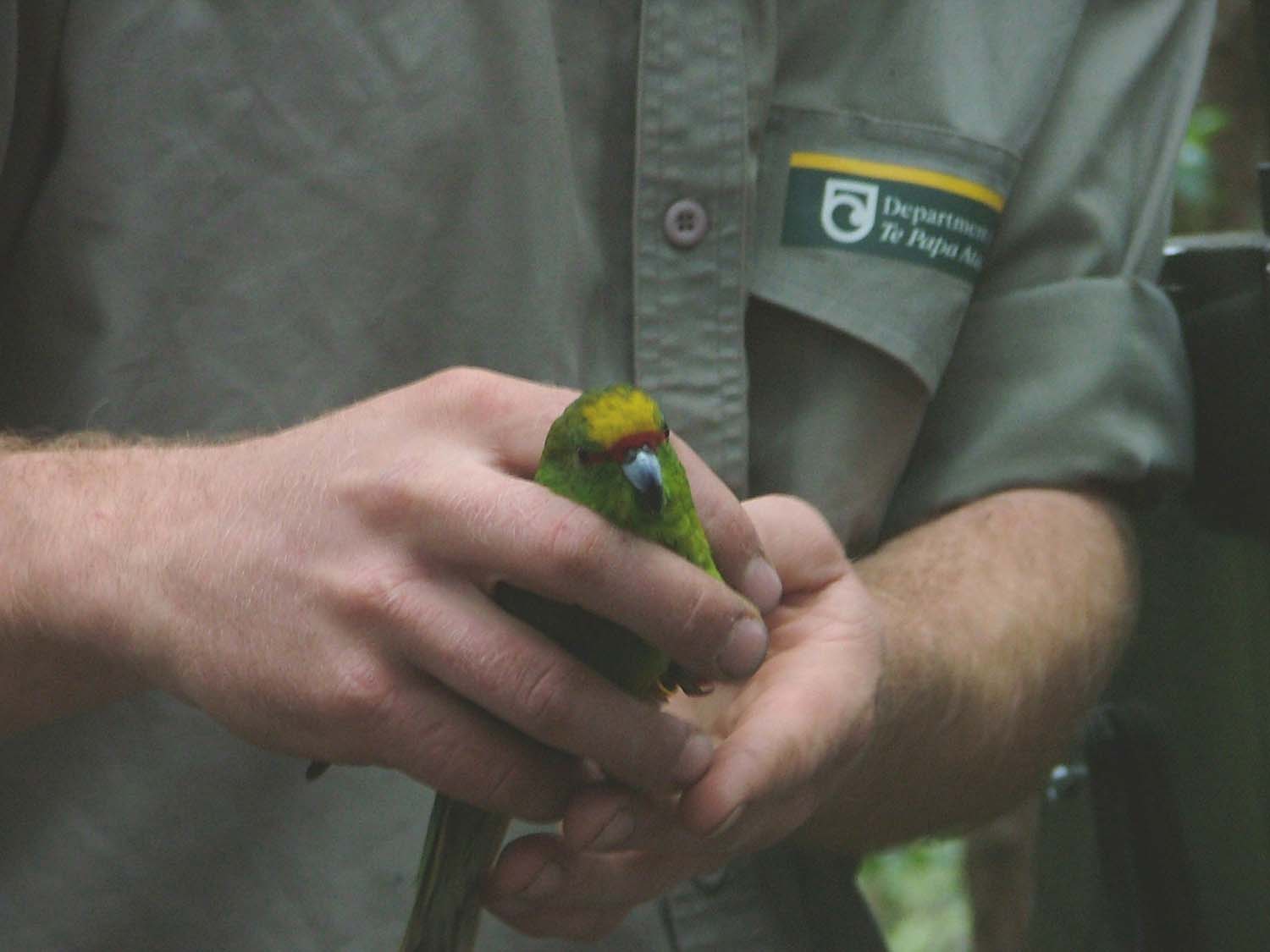
Twenty-six yellow-crowned kakariki and eighty flax weevils were given a new home on Mana Island on Wednesday.
The Department of Conservation, in partnership with the Friends of Mana Island, Ngati Kuia and Ngati Toa, transferred the two species from the Marborough Sounds. The kakariki, or native parakeets, were caught on Chetwode Island, and the flax weevils, flightless beetle relatives, on Maude Island.
Friends of Mana Island (FOMI) president Brian Paget said that the transfers were among a list of species planned for reintroduction to the island. Mana Island was once the site of one of New Zealand’s first sheep farms but is now being restored to its natural state through tree planting, pest eradication, and species transfers.
Offshore islands are valuable for conservation as they can be kept free of predators. Other transfers to Mana Island have included takahe, fairy prions, diving petrels, North Island robins, and green gecko.
“[Yellow-crowned kakariki] are a threatened species, the environments in which they live are diminishing all the time,” said Mr Paget. Conservation Officer Rob Stone said that flax weevils were endangered, and could be eaten by animals such as goats.
Yellow-crowned kakariki are a close relative of red-crowned kakariki which are flourishing on Kapiti Island. Twenty red-crowned kakariki were transferred from Kapiti to Matiu/Somes Island in Wellington harbour last month.
The kakariki were caught by mist-nets placed across flight paths, while the nocturnal flax weevils were caught by hand at night. Mr Paget said “You have to be careful not to shake the bushes or they drop to the ground as a defence reflex and can be hard to find”.
The transfer had gone smoothly, with the release happening a day early as so many birds and weevils had been caught.
The transfer was funded by sponsorship from the Mana Community Trust. Mr Paget said that one of FOMI’s functions was to obtain sponsorship for projects on the island.
FOMI had calculated that volunteer labour on the island last year had been equivalent to having three fulltime staff. This year’s tree-planting season begins on May 22nd.
ends
I got invited along to Mana Island as part of the media to write the above story. There were people from Porirua News, Kapi Mana, The Dominion Post, and a freelancer. We got out to the island - the helicopter had already come and dropped off the birds - and went up the hill to a Manuka grove at the northern end. We took photos of the birds being released (I didn't manage to get any of them in flight) and asked a few questions, all in a very orderly way. Hopefully I'd been forgiven for the mess that ensued with the last kakariki story.
I'd been out to Mana Island once before while working for DOC last year - one of the good things about DOC as a workplace, people get time out of the office every so often to go and plant trees etc. There were six takahe walking along the lawn at the bottom. We spent the day planting trees and the evening collecting diving petrels out of their burrows on the cliffs to count and weigh them (there's a shelter where this is done called 'the petrel station', groan). We also saw the artificial gannet colony (stone sculptures of gannets to attract real ones) and the stereo system which is solar powered and blasts out seabird calls at night, and found lizards under rocks. If you get hungry on Mana Island there's native spinach growing everywhere.
This time was a little less exciting, being there to make a public record of DOC's work. I had to send my story in for 'fact-checking' and again it got cut down - I had put in a quote from FOMI president Brian Paget about where the Mana Community Trust funding comes from: "We have a vested interest in keeping gambling in Porirua."
I can see how that would have been bad taste to leave that in and could have overcomplicated the story - gambling is a major social problem. It does open up a web of interconnections between different things going on in society though.
In the second half of the journalism course we do one day a week working somewhere in the media industry such as a community newspaper. Working with DOC is an obvious choice for me, a good way to make contacts there and learn more about the ecology of NZ (catching up for failing science at high school). On the other hand I've been told that my job there would be writing PR, putting across the DOC side of any story and minimising any negative aspects. If I want to be an investigative journalist and dig up dirt I should go to a newspaper. So that's something to weigh up and decide on. And don't mention 10-80...
http://fiffdimension.tripod.com