May 01, 2004
kakariki politics
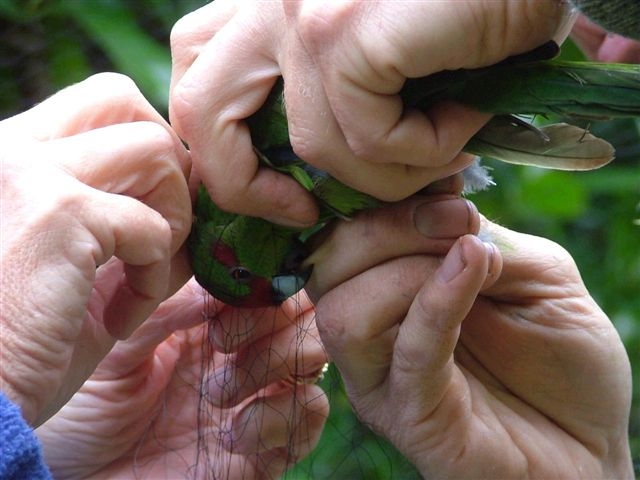
Catching red-crowned kakariki for transfer to Matiu/Somes Island was the job of ten Department of Conservation staff and volunteers on Kapiti Island this week.
The transfer is part of the ongoing ecological restoration of Matiu/Somes, the main island in Wellington Harbour, which began in the early 1980s with tree planting by the Lower Hutt Forest & Bird society. Kakariki lived on the island before humans arrived and are being reintroduced by DOC.
Eleven male birds were transferred from Kapiti last year, and another twenty of both sexes this year to start a breeding population. The new arrivals will be kept in the aviary on Matiu/Somes for a week to acclimatise before being released next Saturday.
Kakariki are a New Zealand native member of the parrot family. They come in three varieties: red-crowned, which are the most common but are confined to offshore islands; yellow-crowned, which have mainland populations but are rarer; and orange-fronted, which are very rare.
Offshore islands make valuable wildlife sanctuaries as they can be kept free of introduced predators, which eat birds’ eggs and chicks. Rats were eradicated from Matiu/Somes in 1987 and from Kapiti in 1996.
DOC Technical Support Officer Lynn Adams said that the red-crowned kakariki population on Kapiti Island was believed to be in the hundreds, and had been increasing since the removal of rats. Twenty kakariki were being transferred, the number chosen to maximise the gene pool while minimising the impact on the Kapiti population.
The kakariki were being caught by mist-nets placed along known flight paths and in the areas the kakariki were caught last year. Other birds that flew into the nets were released.
“They can see the nets as well as we can” said Ms Adams. “They have to fly straight into it. Overcast and still weather is ideal as the net’s not so noticeable”.
Ms Adams said was important to minimise the handling time to prevent stress to the birds.
After being removed from the mist-net, the birds were weighed and their bills measured to determine their sex, then coloured bands placed on their legs for identification. Males have longer bills than females and weigh more on average.
Kakariki were “serial monogamists”, and could lay two to three clutches of three or four chicks in a good breeding year. Those introduced last year have already begun breeding.
Kakariki were good flyers and could leave Matiu/Somes if they wished, but they were expected to stay as there was plenty of food for them. Their diet includes kanuka nuts, coprosma berries, puriri and grass seed.
ends
I wrote the above article last week for the Kapiti Observer. Publicising the first kakariki transfer to Matiu was my first job when I worked at DOC last year, so I figured I'd be helpful and write them a story about this year's transfer. I was also keen to go out and see Kapiti Island for myself, as I'd spent the whole summer looking at it every day from the Paekakariki escarpment.
The trouble is, DOC didn't want any publicity until a few days later, as it would cause problems with funding applications for the Matiu/Somes Charitable Trust, who are paying for the transfer. But they didn't tell me that. So I got caught in a crossfire between DOC wanting to hold the story back and the newspaper editor wanting it right away or she wouldn't publish it at all. It turned kind of ugly, as this was all happening minutes before the newspaper deadline last Thursday.
As a compromise I sent the story to DOC for fact-checking, and they cut it down from 730 words to 420 - which counts as censorship. The story above shows the good side of the transfer, and I think restoring Matiu to its natural state is a pretty amazing & inspiring thing. Human intervention can not only destroy but recreate an ecosystem. It's been going on there for over 20 years now... But let's just say that the transfer's not without risks for the birds, and why's the colony already breeding if they only transferred males last year? There was also a part about the Matiu trust funding the transfer, which they took out - odd since that's public information available on the DOC website. It led me to a paragraph about what DOC are spending money on, which includes trying to save the only remaining population of orange-fronted kakariki, in Canterbury. No idea why they'd want that supressed. Maybe it complicates the story - species transfer to offshore islands is not always a solution, and the orange-fronted kakariki live in beech forests which don't occur on islands. I failed science at high school so all this stuff is new & interesting to me.
Censorship's not something I could let anyone else get away with. It left me thinking I shouldn't have taken on the story at all if I had a conflict of interest. How would I handle a more serious story where DOC could be in the wrong? Not everyone's sold on 10-80 for example... This seems to be one of those things where something that starts off well becomes more complicated as it develops. Working for DOC last year was a fantastic mind-expanding experience but their being an unwieldy bureaucracy is a downside. This is the second time this year I've run into trouble with them - in March they offered me a regular part-time contract at the visitor centre, only to pull the rug out from under my feet when they found they didn't actually have the budget for it. I never got anything like an apology.
Anyway, there's a transfer of yellow-crowned kakariki to Mana Island in May, I'll see if DOC are still speaking to me then. I like kakariki, they've got personality. It all shows how much I've learned in the last year. When I first started last May I had no idea what a kakariki was - I assumed it was a kind of tree...
PS I did some work on http://fiffdimension.tripod.com and improved the mp3s there.