March 31, 2004
Three cheers for Christopher Eccleston
12-3-04 Spent ten or eleven hours out drinking (not heavily but steadily) with some of the journalism class yesterday afternoon/evening... tbc tonight. Not sure what this says about the journalism profession. At least half the people in the student bar on Fridays are in the journalism class. They even scheduled a 'staff/student liason session' at the bar in the first week and put it in the course programme. Oh well they're all intelligent & articulate people so good to hang out with. Still no desire to work on a newspaper for a career though.
24-3-04 Spent the last couple of days at home having sick days, aching all over & congested. With all that free time it’s amazing how little I can accomplish. Not completely over it but should be able to go back to class today. Weather was fine the last couple of days, now it’s raining. Daylight savings ended which is somewhat of a bummer. Fasten seatbelts til late June.
Two-part dream this morning. First part about being on a grey stone coast with Maori affairs minister. He got me to look for pieces of gold, I didn’t find any but did find some metal nuts & bolts which he said would be useful. He said the big rock offshore taking up 15% of the horizon was Maui. Second part of dream was a James Joyce-themed swimming race for school kids. Over-16s paired up with an under-16 each. I swam varying my stroke a lot, including stopping and standing and doing stylized arm movements to reflect Joyce’s varied language in Ulysses. There was acoustic guitar accompaniment.
31-3-04 After spending the last couple of years cultivating a studied indifference to tv and popular culture I’m observing my own reaction to the news that the BBC are – about bloody time – bringing back Dr Who. They’ve cast Christopher Eccleston as the Doctor which is a pleasant surprise, and this generates all kinds of anticipation about what the new series is going to be like. Eccleston’s great in such programmes as Cracker and Our Friends in the North - some of the last tv I actually felt the urge to sit down and watch. I’ve heard The Sopranos is supposed to be good but haven’t seen more than half an episode because I wasn’t willing to give it the kind of time investment needed. I hardly even watch The Simpsons these days, even though my current literary hero Thomas Pynchon makes a cameo in one of the new episodes (with a paper bag over his head). No idea what Fionnaigh sees in Buffy since I’ve never watched it.
Dr Who is the one big concession I’ve been willing to make to tv. I loved it as a kid; Dr Who, Lord of the Rings, and the Hitchhiker’s Guide to the Galaxy were my personal triumvirate of influences. On the other hand I hated WWF Superstars.
Lord of the Rings we all know what happened with that. The guy who introduced me to marijuana at high school also introduced me to Bad Taste – the moment where the sheep gets blown up with the rocket launcher stands out for me as a defining moment in NZ cinema. It took me another year or two to click that this was the same director whose Heavenly Creatures I’d seen with my parents in 1994 (year zero for NZ film). And then he filmed one of my favourite books right on my doorstep and I had hardly anything to do with it (apart from nine days as an extra – I think I made it into one shot in the third film) since I was at uni and didn’t realize how persistent you have to be to get a foot in the door in the film industry. I gradually worked out that bad shit goes on in the film industry but that’s another story. I’m burnt out on Lord of the Rings these days – I’m curious to see if I’ll still be able to enjoy reading the books again, but won’t do it for a while. King Kong doesn’t particularly interest me. Maybe you need to discover these kind of stories in childhood – I saw the first Harry Potter film and found it completely tedious.
It’s interesting how the relationship with early influences continues to evolve over time. I got into Bob Dylan at age 14 and still haven’t grown tired of him, his (best) work is rich enough that I keep discovering new things. The last couple of years have been interesting, the brilliant Love and Theft and Live 1975 albums and seeing him for the second time in concert last year put everything in a fresh new perspective. And there’s the Masked and Anonymous film and the Martin Scorsese documentary on him to look forward to. Live 1964 gets released today, not sure if that will have so much to say to me since he’s 22 at that point and I’m now 25.
The Hitchhiker’s Guide to the Galaxy also changed its tone for me as I got older and realized just how dark the satire is. I also read Last Chance to See, Douglas Adams’ non-fiction book on endangered species (including a chapter set in NZ about the kakapo), which shows another side to the author. His biography, Mostly Harmless, paints a somewhat sad picture of someone who got rich & famous early on and then struggled with writer’s block for the rest of his life. The discovery that he was very tall also reinforced him as an identification figure – anyone notably tall or short or fat or skinny or brainy or stupid gets picked on at school (though he was 6’5”, I’m only 6’3”). The death of Douglas Adams coincided eerily with me getting my first published short story in Takahe magazine – issue #42.
As for Dr Who, it ran for 26 years and went through such a range of styles and material, comedy to high-concept SF to darkness and back that it’s impossible to predict what the new series will be like. Its versatility is its great strength – the format even thrives on having a change of lead actor and style every few years – so there’s no reason why a new series couldn’t be something really cutting edge. Hopefully it’ll be something adults can watch without feeling embarrassed – the original show is severely cheesy at times. Fortunately they’ve got an interesting choice of leading man (on whom the show largely depends) and some writers with a good track record. Great dialogue will be essential to make it work.
When the series ran on Prime in 2001 I spent a fair bit of time getting the episodes on video and watching them again. A lot of it’s crap, at least from the perspective of being now older than ten. There are moments of brilliance though. I tried to introduce my nephews who are SF fans to the program, and being from a younger generation they couldn’t see past the low-budget special effects. Maybe the new series will convince them? I’m just half-surprised that it’s not being shot in NZ, otherwise I’d be having second thoughts about giving up on working in film…
A new series will be a great shot in the arm to make Who something living again, rather than locked into the nostalgia death-trip. Dr Who was not cancelled but indefinitely suspended after 1989 - although it did survive in book form. Apparently the writers of the books were able to introduce heavier concepts and go deeper into the characters than the tv series could. I approve of the idea, but wasn’t willing to delve into the books for fear of getting trapped into fandom. I started getting my SF hits from Greg Egan and Philip K. Dick instead.
Would it be selling out for me to start watching tv again? Should I be worried about the dangers of the ‘electric nipple’, as tv’s been described by sorry can’t remember who? Would I be too seduced by the opiate of the masses to pay attention to more important things? I don’t own a tv at this point and don’t miss it at all. There’s still nearly a year and a half to wait before Dr Who returns and I might want one again…
March 16, 2004
The Space
This is a big entry. It's the first draft of a chapter I've been writing about The Space for a book on jazz in NZ - anyone interested in the cultural history of Wellington (besides LOTR) in the last few years should hopefully find it interesting?. Any comments/criticisms most welcome...
The Space
by David Edwards - http://fiffdimension.tripod.com
(8322 words)
“Well, I don't know what jazz is. And what most people think of as jazz I don't think that's what it is at all. As a matter of fact I don't think the word has any meaning…”
- Cecil Taylor
“Happiness is a journey not a destination”
- Jeff Henderson
In March 2000 the American trumpeter Wynton Marsalis, described in the NZ Festival programme as “the most acclaimed jazz musician of his generation” played a concert of Duke Ellington tunes in Wellington. The same night the Ecstasy Trio, a local band of Jeff Henderson on reeds, Tom Callwood on double bass, and Chris O’Connor on drums were performing at the small Cuba St art gallery the New Works Studio. “Wynton Marsalis” declared Henderson introducing the band’s set, “this is not for you”.
The Ecstasy Trio were one manifestation of Wellington’s turn-of-the-millennium improvised music scene, which largely revolved around the Newtown venue The Space during its existence from September 1999 to April 2003. Bringing together three of the scene’s stalwart players, the trio often played there every week, or every night for a week. Ecstasy Trio performances were notable for their kinetic energy, the complex intuitive interaction taking place at high speed, volume and intensity. Passages of quiet and gentleness would suddenly appear or be replaced by roaring squealing climaxes in which fragments of tunes could just be discerned. Circular breathing, drones, multiphonics, vocalizations, cymbal-scrapings and other ‘extended techniques’ were regular parts of the armoury.
Chris O’Connor left Wellington for Dublin in 2003 and having been an energetic collaborator in a varied multitude of bands and projects his departure marked the end of an era as strongly as the closure of The Space and its metamorphosis into the new venue Happy. The Space era 1999-2003 has a specific time, place, and community of people involved so it should definitely be counted as a period and scene in New Zealand music history, which produced a wealth of ideas, performances and talent - even if it went largely unnoticed by the general public. The Space was conceived as a workshop environment, a place for experimentation and for players to develop their confidence and skills. It was run primarily by and for the artists, and was a place where challenging or avant-garde work would not have to be marginalised. With irregular gigs in galleries and pubs no longer enough to properly nurture all the creative energies flowing, the venue was started to give the players somewhere regular to play.
Jeff Henderson: “To be happy with my music I need to play it a lot and have periods of really good development and that can only happen in front of other people. Also I wanted the music to be accessible… nothing about the content being accessible but it has to be able to be accessed, which means it has to be there and happening, so it can’t be hidden away in a shed” .
The name The Space suggests an empty canvas, and indeed the opening night was a gig by a band called Blank Slate Technology. According to Henderson the name was “not very interesting at all actually. We didn’t have a name for it, it was just the space we’d rented. That was it, nothing very spiritual or anything”. Still, the neutrality of the name fits in well with the scene’s at least theoretical openness to all contributors and possibilities. By contrast Happy, the name of the current venue which succeeded The Space, suggests a more fixed agenda. Most of the regular performers at Happy are the generation who played at The Space but there is an increased commercial pressure owing to the higher overhead costs and a sense that the music has moved beyond its developmental stage. “Happy is a venue where you have to be good already to play” says Henderson. In a sense things have come full circle with less established players again having to find small alternative venues, such as the Newtown Community Centre or Photospace Gallery on Courtney Place.
Happy is located in downtown Wellington and functions as a bar and nightclub, whereas The Space was located in the suburb of Newtown and served as an art gallery, bookshop and venue for yoga classes as well as a performance space. Coffee and food were served after a while but alcohol only when a temporary license was obtained for festivals. The distance from downtown, lack of alcohol and the lack of mass appeal for much of the music meant that audience sizes were often small. In one case the bands Birchville Cat Motel and Negative Eh gave a gig that no-one at all turned up to! This brings to mind the riddle of the tree falling in a forest – is a gig with no audience still a gig? Nonetheless The Space had a large influence on the people involved.
Kieran Monaghan: “Prior to The Space noise/free gigs were sparse (that could be read a few ways). But the Space did become a good focus (and was just down the road from where I lived). I loved the fact that it was in Newtown, it use to piss me off that everything was in the city centre, it really appealed to my sense of community. And a community evolved around it, it had a great impact on the wider communities as well. I also enjoyed that The Space used to be visited by Kieran, the Downs-syndrome boy, and a bunch of other people from Newtown with psychiatric conditions. Interesting music in Wellington seems to be cyclic - dry times and thrive times. The Space managed to extend one of those thrive times for 3½ years with terrific results (and a few real bombs).”
Identifying a ‘Space sound’ may be pointless since the scene included a range of different people and approaches. Improvisation was emphasized but not exclusively. The Space sound if any is the sum total of all the music that was played there, which included pop, punk, electronica, singer-songwriters and so on. One of the more popular fixtures in the calendar was the monthly Girls in Space night, featuring all female performers of whatever style. However a number of women musicians including saxophonist Bridgett Kelly, vibraphonist Nicky Lillicrap, and bassist/cellist/accordionist Maree Thom identified more with the improvisation scene than Girls in Space, indicating that instrumental skill and the ability to interact musically is the issue in improvisation and not gender politics.
[insert Maree quote?]
Despite its variety some people played at The Space more often than others however and there were recurring elements, such as Henderson who is described in one of his posters as an “improvising saxophonist, loud, prone to outbursts of wild screaming, has been described as a ‘multi-millennial roaring rhino’, also capable of sweetness and subtlety”. Also, with Henderson as manager/curator of The Space the music overall was to an extent a reflection of his tastes. As a jazz school graduate who had preferred the ‘out’ jazz of Albert Ayler and Ornette Coleman to the traditionalism of for example Wynton Marsalis, there was an emphasis on experimentation, collaboration, openness to dissonance, and using improvisation as the chief working method.
Jazz is an artform that emphasizes improvisation, and is a major background influence for many but by no means all of the players. The jazz conservatory at Massey University has been one source of people and a reason for the scene taking place in Wellington. For all The Space’s claims to represent an underground alternative, it was also a part of ‘the cultural capital’. Others have studied composition at Victoria University, with its electro-acoustic composition facilities proving popular, while others again have no formal training at all. Part of what makes the millennial Wellington scene distinctive is this melting pot aspect, and the fact that many of the musicians cite other locals as major influences. The scene thus has a strong sense of community and local identity, and enough critical mass to be self-sustaining.
Kieran Monaghan: “I became interested in interesting music by a combination of some great friends in the Dunedin punk community in the late 80’s and an inquisitive taste and short attention span… Myself and a couple of others formed probably the only Industrial band ever in Invercargill in the late 80’s called Cubicle, using washing machines, and old steel, and home made instruments, a precursor to the noise movement but with rhythm. I specifically came from the punk end of things, the philosophy that technique was not the be-all and end-all - desire and enthusiasm were the reasons you wanted to play [italics added]. I admired the collective working of organising gigs early on, but drugs often fuck up something unique. It was perhaps this style of working which really interested me with The Space - the music was not was I was used to but the style of just doing it was.”
What free improvisers, post-punk noise artists, underground theatre performers and avant-garde composers have in common is the element of individualists standing against the mainstream of their respective traditions. Guitarist Chris Palmer - who cites BB King, Bartok, Charlie Parker, Ornette Coleman, Derek Bailey, Captain Beefheart, Sonic Youth, Stravinsky and Birchville Cat Motel as influences - says “it’s more of an ideological influence than a direct sound influence”. In this sense there are parallels between all forms of avant-garde art.
It is also something of a cliché that radical music creates opposition, the infamous Rite of Spring premiere and so on. A.B Spellman’s book Four Lives in the Bebop Business, which Henderson cites as influential describes Ornette Coleman getting beaten up and having his saxophone smashed after a performance. There is a certain romanticism in the idea of the radical artist struggling against ignorance and opposition which some may take as inspiration. In practice however the major problem is finding venues willing to host challenging performances, so The Space was started to provide a welcoming environment - or as Campbell Kneale put it “you’ll always get a receptive crowd even if it’s just the door person”.
Jeff Henderson: “The music gets negative reactions all the time, but that’s probably a good thing – it shows that it still has power to challenge people. One time in Palmerston North we got a loud audience, I finished thinking ‘that’s a good response’ – it turned out that half of them were booing. It hasn’t come to physical violence though”.
One way in which players from different backgrounds can meet up is through free improvisation, which is by its nature leaderless and non-hierarchical (at least in theory). Free music as a genre has its roots in the free jazz revolution of the 1960s, since which time jazz players and listeners have been divided into pro- and anti-free camps. In rock music, punk caused a similar shakeup in the 1970s. While punk’s stripping down of rock to its bare essentials – ‘here are three chords, now go form a band’ – often leads to creative stagnation and sonic conservatism its democratic accessibility is a great strength which jazz, requiring years of learning to play, arguably lacks, and many players used punk as a starting point from which to develop more idiosyncratic styles. To post-punks raised on dissonant bands such as Sonic Youth, the idea of free improvisation, with its encouragement of stylistic individuality, can come as natural.
Campbell Kneale: “Although I do not possess any academic qualification in music I consider myself to be very well trained. I've been performing original music, and generally trying pretty hard to develop my unique little area in music (which has had many forms) for the last 18 years. I don't feel in the slightest bit disadvantaged by lack of formal training, in fact I feel very liberated, and have every confidence that I could play ANY given instrument with ‘musicality'”.
Free jazz was originated in the 1960s mainly by black American musicians such as John Coltrane, Ornette Coleman, Cecil Taylor and Albert Ayler. The European brand of free improvisation came slightly later as a reaction to free jazz, influenced by it but consciously avoiding jazz sounds and rhythms in favour of players experimenting to develop highly individual ‘non-idiomatic’ styles. Derek Bailey, Peter Brötzmann, Evan Parker, Tony Oxley and bands such as AMM and the Spontaneous Music Ensemble are some of the pioneers of this. In both cases free improvisation came about as the result of a logical progression. To extend the harmonic possibilities opened by bebop further, into atonality, jazz players stopped using chord changes, which then allowed the steady beat to be removed as there was no need for bar lines. This in turn removed the hierarchy between soloist and rhythm section, so bass and drums can be lead instruments .
Simon O’Rorke: “With free improv, drums are optional. Where there is a drummer or percussionist in a freely improvising ensemble, their role is really much the same as that of any other musician: to listen to the other players and respond to them with lines that differ from but fit in with what they are playing. Free improvisers play with an implied "pulse" rather than with a laid-down beat, so the drummer's time-keeping function is not only not required but in general is to be avoided. ”
In New Zealand another style of free music evolved out of the 1980s post-punk scene - South Island bands such as The Dead C, Surface of the Earth, A Handful of Dust and Sandoz Lab Technicians recorded for the Xpressway and Corpus Hermeticum labels run by Bruce Russell. As its origins are closer to punk than jazz it gets labeled ‘noise’. As with free jazz it developed via a logical progression – the record label Flying Nun was started to document NZ’s independent rock scene, Xpressway came about to give exposure to the more uncompromising artists who were getting ignored by Flying Nun, and Corpus Hermeticum came about once the music had evolved to the point where it was no longer recognizable as rock.
Bruce Russell: “For myself Sonic Youth in the period 1986-88 were a big inspiration in terms of taking rock forms and pushing them further. I listened to a lot of American rock of that era but most of the 'grunge' stuff was pretty lame. I think there was a lot of interest in the Dead C. in the early 90s, and less since, other than that it’s hard to judge… Certainly my background is not really musical in a real sense, I can't play the sort of chops those [jazz] guys can. In practice this means little, to me at least. I play with people who can really play, and they seem to accept me OK. I don't object to technique, it’s what you do with it that counts, ditto lack of technique.”
Thanks to Russell’s distribution efforts this music is relatively well known overseas whereas the Wellington scene remains obscure - to the point where the liner notes of the first album by Wellington improvising trio The Slab stated “New Zealand has a well-deserved reputation for producing free noise music, but that is rather different from what you will hear on this CD.” The Corpus Hermeticum scene has had a wide influence but not on all the Wellington musicians, and Bruce Russell is one significant figure who never played at The Space. Interestingly Cloudboy, probably the Wellington band with the closest connection to ‘the Dunedin sound’, became very popular, and were one of the few acts who could draw a standing-room-only crowd at The Space. Dunedin may no longer be the thriving music centre of legend but the music from there carries historical weight in New Zealand and overseas.
Chris O’Connor: “I didn’t come from Dunedin, I grew up in Wellington. It wasn’t a big influence on me at all. It was interesting after getting into improvised music to realise that there are guys in the South Island who have been doing it down there for a wee while now, like the Dead C and those chaps. But I didn’t realise that those guys were doing stuff until after I’d gotten into it already. And it’s good to see that.”
A bigger local influence on Henderson and O’Connor were the musicians who played in Wellington bands the Primitive Art Group and the Six Volts in the early 80s. These bands had broken up due to tension between the members who wanted to play song-based music and the more hardcore avant-gardists, but they continued on in various subgroupings – “they were playing grooves and things, jazzy stuff, it wasn’t free improvisation but it was inspiring – they had great passion and knowledge for the music” says Henderson. Drummer Anthony Donaldson remains an active member of the scene.
Anthony Donaldson: “In the ‘90s there was the Braille Collective, which had thirteen subgroups, and before that the Primitive Art Group. The ones who are still around are in the Labcoats, along with guys from the Muttonbirds and Trinity Roots who see it as a side-project. It’s not really part of the Happy scene… When The Space started I’d been away on a two-year horse trip in the South Island. I wasn’t thinking about music at all, I needed a break from it. The Space started everything up again – I had to sit down and practice for six months. Now it gets busier every year.”
Another important precedent was the theatre company Red Mole. This was started by New Zealanders Alan Brunton and Sally Rodwell in the 1970s and was based in America from 1978-88. Their work emphasised dreams, irrationality, and lifelong commitment to one’s art. “Red Mole places priority on feelings and emotions in a theatre for intuitions and sights into the human condition. To present is to be present…Red Mole asks questions but doesn’t indulge the vanity of answers”. Brunton & Rodwell acted as godparents to The Space scene, collaborating with musicians and encouraging younger performers through their Roadworks shows which had a no-auditions policy so that anyone who wanted to take part could do. What turned out to be Red Mole’s final show, Grooves of Glory, premiered at The Space. When Brunton died of a heart attack while touring the play in Europe in 2002, the news came as a death in the Space family.
Kieran Monaghan: “I did four shows at the Space with Alan & Sally, Radio Radio was the first and was quite early on in the life of the Space, [then] Compestella, Epiphany Locks, and Alias Monk. There was pretty much free rein on what you could attempt, Brunton was very blunt as to whether he liked what you were doing, and one week you'd do one thing and he'd like it, the next week he'd think it was crap - so kind of frustrating. There was this amazing dynamic between Sally and Alan, they could argue like nothing else - it became quite funny after a while, best not to get involved in it, but the result was always a testament to the effort and passion that they would spend on it. I would hope (and it think it was Alan’s and is Sally's) that people who have had the experience will go on to create those sort of environments for others as well, I think that is really an important aspect of their work… There is a big hole where Alan should be, his death shook me in ways I had never expected, and it has taken me quite a while to come to terms with it. I don’t think I realised how important his friendship was - who does when someone is still alive? The History Wringing [album] was me going through my own process of grief, and also a refusal: that even though he is gone I am not dependant on his creativity to produce performance.”
Through the ‘90s pieces of a puzzle started coming together as various people in Wellington worked on different projects. Brunton & Rodwell returned to Wellington; Jeff Henderson formed the band Syzygy, billed as a ‘creative music ensemble’ to distance themselves from jazz, and toured the country with their album Tongue Grooves; percussionist Simon O’Rorke, an English immigrant who had discovered free improvisation in London in the 70s, formed the improvisational trio The Slab; Campbell Kneale started putting out recordings as Birchville Cat Motel; the band cl bob were active, who “could go from a Dixieland feel with banjos to a heavy Neil Young/ Hendrix guitar freak out, on to a completely free non-metered improvisation followed by a Bossa Nova with vocals - we do country as well” ; and many more. cl bob guitarist Simon Bowden became director of the Wellington Jazz Festival which provides an important annual musicians’ showcase.
There was also a magazine called Opprobrium that came out of Christchurch, which featured a mixture of in-depth interviews and reviews of various noise and improvised music. While not directly related to – in fact largely unaware of - the goings on in Wellington (apart from a rave review of the first Birchville Cat Motel album), Opprobrium set an interesting precedent. In 1998 Opprobrium put American bassist William Parker on the cover, and later that year Parker was in Wellington for the Jazz Festival, where he conducted a big band of local musicians. The 1998 Jazz Festival showed that a strong community existed and The Space became its logical culmination.
Simon Bowden: “This [William Parker] concert had a big effect on the audience - most of the older jazz club types who came hated it, "this is not big band jazz!" It had the effect of polarising the audience and forcing us to look to new audiences for our music… some used to think that there was a natural progression for an audience: start them on Dixie, move onto Swing, then Bebop, Fusion and then Free Jazz. This is completely incorrect; our audience has come from a variety of places including noise music, indie pop (Tortoise gig in the 2001 Festival), guitar bands like HDU etc, even dub. The old jazz audience will never be into our music, they are in it for different reasons.”
One of the major events in the history of The Space, shortly after it opened, was the visit of English saxophonist Evan Parker, one of the key figures in the European Improv movement (and who had also been on the cover of Opprobrium). He spent an evening jamming with local players (which was advertised only in a low-key way as a ‘mystery evening’ but brought a packed house) and also gave a talk about his own music and various approaches to improvisation - “in the Spontaneous Music Ensemble we had rules, such as if you can’t hear the bass player it means you’re playing too loud - whereas with the Peter Brötzmann Octet if you can’t hear the bass player that’s his problem!” He also made the comment that a lot of the Wellington players’ styles sounded midway between the American and European modes of free playing. This is fitting as New Zealand culture in general is heavily influenced by European heritage and American media saturation, and both continents are equally far away. It should be noted however that the players who jammed with Parker were generally those with ‘jazz’ rather than ‘noise’ backgrounds, and that this was early in The Space’s history so a more distinctly local style may have developed over time.
Jeff Henderson: The music’s evolved out of our influences, which are American and European improvised musics, and also Pacific music – we can’t help being influenced by what’s around us. It would be silly really for me to sound like an American jazz saxophone player because I’m not. Maybe he [Parker] was meaning that the music was still in a developmental stage; maybe he recognised that it wasn’t trying to be just one thing”.
Chris Palmer: “We are different from Europe or America – people say that rural music is more laidback. When I listen to stuff recorded here I would say it’s more laidback and less intense. People could take that as a criticism that we don’t play like New Yorkers, big deal but I don’t see that as a problem at all. That’s probably our sound. Its maybe not laidback, it’s definitely quite intense and fast, but it’s less kinetic and less frenetic than the [Cecil Taylor] Feel Trio or the Slippenbach Trio or a lot of Japanese stuff. If you sound like what you’re going for is real intensity but you’re not getting it, then that can be a problem. So what we have to do is find ways to make the more contemplative or ruminative sides to our music an assett. It’s not a question of marketing, it’s a question of finding what works in what we’re doing and refining it”.
Evan Parker’s visit also gave an opportunity to make a conscious attempt to give a local identity to NZ free improvisation. Evan Parker’s concert at the Paramount Theatre as one of the headline acts in the 1999 Wellington Jazz Festival was in two parts, a solo set and a series of duets with Richard Nunns on Taonga Puoro, or traditional Maori instruments. In this case the challenge was to unite Parker’s highly evolved and expansive style with Nunns’ eerily evocative but dynamically and tonally limited woodwinds, gourds, shells, and greenstone percussion. According to Nunns, when Parker began his set a few people walked out early on, but the majority of the audience knew who Parker was and what to expect - so by 1999 a lot of groundwork had been laid for players and public. The concert recording was released as the album Rangirua on the American label Leo, the first significant international release from the scene.
Jeff Henderson: “Evan Parker's music would appear to come from vastly different sources [from Richard Nunns’], however at the heart of all ancient music is one binding element: improvisation. There is no conceivable way to notate Evan Parker's music, and the same goes for Richard Nunns'. Their music is created spontaneously, it involves working with the miniscule nuances at the outer regions of the fundamental sound. Evan Parker taps into ancient traditions -most importantly the ancient tradition of improvising! Circular breathing, trance states, drones, harmonics can all be found in the music of ancient cultures throughout the world (the Australian Aboriginal didgeridoo for example). While Evan Parker makes strikingly modern music, he has deep roots” .
One of the strengths of Wellington improvised music has been the emphasis on playing with people, including overseas visitors. Performances such as the Parker/Nunns concert, the William Parker big band, or the Urban Taniwha 2000 big band which brought together around 15 local instrumentalists along with Richard Nunns and American pianist Marilyn Crispell, function as hallmarks. Successful collaborations with international ‘name’ players indicate that a certain level of quality has been reached. They are a way of getting recognition, a good thing for musicians to put on their CVs, and reflect the development opportunities afforded by frequent live performances at The Space. As Henderson put it, “the music’s got better and better – there’s nowhere else that would let me play solo for two hours and turn off the coffee machine”. Crispell enjoyed her experience enough to return for another tour with a six-piece version of Urban Taniwha in 2002.
Jeff Henderson: “If we’re going to bring people from the States or from Europe all the way out to NZ, we didn’t really want them to just do a gig and then bugger off like it was any old date anywhere in the world. It didn’t seem worth their while or our while. We always wanted to initiate some kind of collaboration that would challenge them or interest them the artist and maybe recognise that there are some important things going on here… Marilyn Crispell loved it. A lot of people from Europe and the States have never been this far over to the South Pacific. She was taking a big chance, trusting that there were some decent musicians over here. I sent her a book called Wahine Toa, which has paintings and writings about women in Maori legend, saying this is some of the stuff that’s inspired the music. She had to trust that because we were asking her to come over we knew her music and that it would work. She was taking a leap into the unknown really.”
The Urban Taniwha project brought a strong Maori influence to big band jazz, suggesting a self-conscious desire to deliberately create a Pacific music. In Wellington, jazz has often been one ingredient in a mix. Jeff Henderson has collaborated with musicians from other traditions including Richard Nunns, Indonesian percussionist Agus Supriawan, and local ‘noise’ artist Campbell Kneale who records as Birchville Cat Motel. The album of the latter collaboration, Swarming Tamagotchi Plague was described (approvingly) by American magazine Bananafish as “no dumb quotes to imply that these guys really know how to play, just sweet fingernail/chalkboard reunion” . Possibly traditional forms of music are concerned with refining and perfecting themselves as traditions (classicism), whereas the fringes encourage individuality and are more open to other influences (ie freer). Free music can be seen as an area where different styles of music overlap and blur into each other.
Jeff Henderson: “The whole thing with Agus was as an improvisor to play with a diverse range of people from different cultures. You want to find ways of playing together. I haven’t studied Gamelan music, so you try and find ways to interact and make some good music coming from where you’re coming from... You have to discard a lot of things that maybe you can rely on with other people. Like playing with Richard, to expect him to play in tonal centres and things like that, it’s not going to happen. Life would be kind of boring if you always played with people you had a similar approach to. I’m into playing with someone like Campbell Kneale and doing lots of noisy stuff or whatever – that’s what I love about being an improvisor. You’re able play with anybody really as long as they’ve got a kind of open aesthetic”.
Chris Palmer: “the greater the population the more you can specialise as a rule – and we can’t really specialise at this point. But it can be itself a kind of uniqueness when you put together musics with different philosophical motivations that would normally never get played together… I think that’s a strength”.
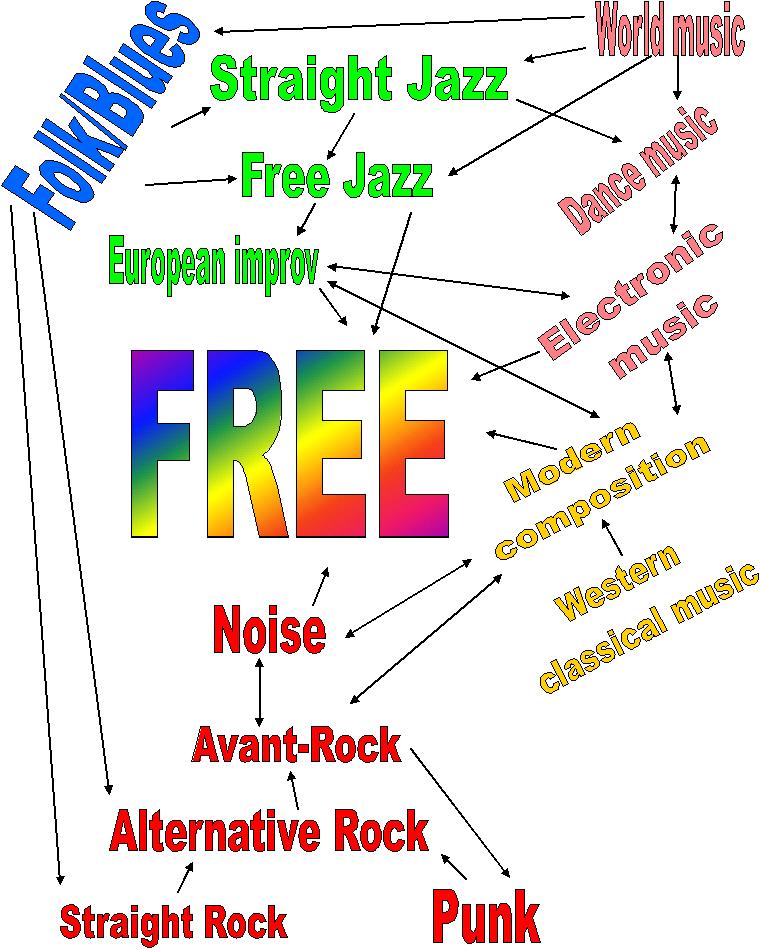
The diagram suggests some possible links or lines of influence between different areas of music, with ‘free’ in the centre, not so much as another genre of music as an abstract ideal – the point where everything else can meet.
Campbell Kneale: “I guess free music is a very fundamental kind of music making. It’s at the root of just about any kind of music you care to mention, after all how else do people come up with new musical sounds and ideas other than just jammin' around?”
In practice however free music’s unrestricted openness to any sounds the players wish to use means that listeners unaccustomed to free may find it difficult or unpleasant to listen to. There are no keys, chords, melodies or steady beat, or if there are they can be discarded suddenly. Free music is mercurial, constantly in flux. The only rules are to listen and respond to the other players. American guitarist Alan Licht says that ‘songs are bottled water, improv is running water’. The emphasis is on process rather than product. Asked to explain the name Happy for the new venue Jeff Henderson said ‘happiness is a journey not a destination’ - flippant but maybe revealing. The analogy between collective improvisation and conversation or communication in general is sometimes used. Each individual brings their own stylistic contributions, and the whole is hopefully greater than the sum of the parts. People rather than instruments are the main resources, ‘the composition begins when the players are chosen’ as Cecil Taylor put it . The logical conclusion of this would be to see The Space as a single piece of music lasting 3½ years.
Jonny Marks: “Cross-pollination has a lot to do with social rapport – people have to enjoy being together to play together. It should get to the point where playing a musical joke for example comes as naturally as a verbal one. And maybe someone into free jazz is attracted to the same kind of rawness that the rock player who’s into free noise rather than Genesis hears”
The idea of process is important, with a continual evolution in players’ styles. Most of the regular players continually tried new sounds, instruments and approaches in performance. At times the notion of playing, in the sense of childish experimentation was invoked, such as in the Huttstock performances which featured an evening of various ‘noise’ artists making sounds from amplified wine glasses, pitch forks, and homemade electronics; the Fringe Festival 2001 show Meatworks: The Guts & the Glory, a multimedia event exploring the idea of meat in many forms, which featured among other things a puppet made of sausages dancing into a heated frying pan and the sizzling being mixed into the music; and Mod-Con De-Con, a week-long festival of music made with toys and household objects. The latter event was given a strong publicity campaign including a full-page newspaper feature and a spot on the tv news, but attracted a poor turnout, suggesting that even the regular Space crowd were uninterested in going this far from the ‘mainstream’ or considered the idea self-indulgent.
Since free music is usually ignored by the media in New Zealand people are not likely to hear any of it unless they look for it. Saxophonist Bridgett Kelly says “listening a lot leads to a natural development of your listening ability, which in turn leads to the search for more interesting sounds/energy”. This suggests that listening to music is as much of a skill as playing it, and that people who listen to music actively rather than passively are the most likely to enjoy free music.
There can be a progression in tastes towards free – people need a starting point from which to discover it. Tom Callwood for example draws a clear line in his listening development from conventional jazz to John Coltrane to John Zorn to free, while guitarist Craig Taylor simply says ‘I’ve always been interested in dissonance, which led to the avant-garde’. On the other hand Simon Bowden says “it is a common misconception that people start by liking one form of jazz (say bebop) and then ‘progress to improvised music’. We live in a time with no categories - most people think this way now...” It may not be a coincidence that free music evolved in western society’s ‘postmodern’ era, and like all art it offers a reflection of its time and of parallel developments in the other arts.
Campbell Kneale: “I can only speak for myself, but I am attracted to 'noise' (or a sound-world that doesn't necessarily involve rhythm, melody, harmony, notions of 'groove', 'accessibility' etc) in the same way people are attracted to abstraction in the visual arts. It’s non-literal, not self-consciously 'meaningful', its surface texture is its content, and lets not overlook the fact that loud noise is incredibly sensual - a blind-man’s Rothko. Although I suppose you could trace my musical lineage back through outfits like Thela to the Dead C, I certainly don't fit that easily alongside these artists. They were like mutant rock bands really. I'm like a mutant orchestra.”
The expectation that there won’t be a tune or steady beat leads to accusations that free music is in fact a generic form with its own conventions, much like any other kind of music. For this reason I placed ‘free jazz’ and ‘European improv’ as separate categories from ‘free’ in the diagram. A lot of the music at The Space did have a beat, at least some of the time. The word free can be taken in positive and negative senses – does it mean ‘freedom to’ or ‘freedom from’? There are no absolute answers but a range of different approaches which have ensured variety in the music. A flyer for a gig by Simon O’Rorke’s trio The Slab advertised them as “improv in the European style”, indicating that there are subgenres within the area of free improvisation.
Chris Palmer: “I don’t think it’s subject to fashion down here, because we’re so isolated and a lot of people here are very anti-fashion. When we listen to the music we’re listening to stuff from the late 60s adjacent with stuff from the 90s or 80s or whatever. We’re less aware of when stuff was released, we just listen to the music. Whereas reports from overseas, particularly Europe, are of a kind of oscillatory fashion movement. Apparently the full-on free-improv is out of fashion in Europe and they’re into hyper-noise and electronic glitches these days.”
Free improvisation is a method of working in which everyone is equal. When European improv evolved in the 1960s there was talk among bands such as AMM and the Spontaneous Music Ensemble of improvisation being used to overthrow ‘the tyranny of the composer’, and they drew parallels between collective improvisation and socialism . Likewise American free jazz had links to the black civil rights movement. In NZ 30-40 years on these issues have become background, as Palmer implies, which players may or may not take into consideration for their own music. There is also a certain wariness of free improvisation becoming a dogma in itself. In any case the mr sterile assembly (deliberate lower case), perhaps the mostly overtly politicized group in the Wellington scene, tend to work with a rehearsed repertoire of songs. They blend punk with cabaret through the use of costumes and stage moves but improvisation is not a large part of it.
Kieran Monaghan: “As a music player, I often think this is true, ‘free music’ does not necessarily equate to inspired music. I love passionate music but I also love storytelling and collective and considered working. And not only can free be perceived as more fun to play than listen to, it can also develop itself into an insular, elite group which is difficult to access from the outside, and this may not be perceived by the group themselves. Why is it not more popular? What story does it tell? Who is it talking to?”
Improvisation is not always a purist end, and another of the more ‘popular’ artists from The Space and Happy is pianist and singer Leila Adu, whose arrival on the scene Jeff Henderson describes as ‘a shot in the arm, someone bringing a strong personality and her own ideas about composition’. Free music does tend to arouse suspicion from a lot of listeners and it remains a marginalized form of music. The issue is probably largely to do with listeners’ tastes and lack of exposure to or understanding of it, and it is generally clear to experienced listeners that there are good and bad examples of improvisation just like any other kind of music. There are differing opinions on how best to reach an audience.
Simon Bowden: “My personal opinion is that things are changing. Improvised music has only been performed regularly in Wellington over the last four to five years. It was and is still developing. During the stages of development musicians needed to spend a lot of time looking inward (listening to each other and trying things out on the gig) - the result was that they did not always connect with the audience. This is still the case for some musicians that have not developed a mature sense of connecting with the audience or of playing with self confidence. I now think that there are numerous examples of improvised music where musicians connect with the audience - sometimes there is a deliberate device used, such as theatrical elements or multi media. Anthony Donaldson has had a huge influence on the scene with his focus on connecting with the audience. One other point - as there used to be no audience for improvised music, musicians felt "no one cares anyway - I will do what I want", or "I will make weird sounds so that I don't sound mainstream" - with the growing recognition for the music this attitude is now a thing of the past (mostly). So - less and less people will say it is more fun to play than to listen to as they feel included... things are changing and will continue to get better.”
Simon O’Rorke: “improvised music is uncompromising in refusing to be influenced by preconceived notions of what audiences like - but the self-expression aspect of improvised should not be exaggerated. Another avowed aim of improvised music is to fit in with the other musicians. In that sense, the music can be particularly selfless rather than selfish from the perspective of an individual performer. The contradiction between the twin aims of self-expression and co-operation give the genre vitality. And self-expressive music can be more moving to a receptive listener than music where self-expression has been sacrificed to the aim of pleasing the audience.”
Groups who do make improvisation a large part of their method may use it as a specific element of the music, or approach it in a particular way. Many of the groups at The Space were comprised of people from the same pool of local players but in different combinations or using a different ‘concept’ - hence the bewildering array of band-names that one is confronted with when looking through the Space archives.
Campbell Kneale: “Within this very wide area of music, the use of improvisation as a compositional tool varies from person to person. Some improvise exclusively, others compose rigorously. I suppose I do both. I try and get a feel for the performance venue, and the number of people potentially turning up, the size of the PA etc, and try to form a one-off show specific to that kind of space. I assemble a collection of equipment that will produce a certain range of sounds that sit comfortably within that initial vision and improvise within those relatively tight parameters on the night. I compose the equipment, and improvise the music. How successful that improvisation is, that’s a pretty personal judgement call I mean, how do you judge a good rock song? You just know, right? It goes down easy and it moves you somehow.”
Chris O’Connor: “The Rubbernecks came about because Dan [Beban] had been collaborating a lot with Anthony [Donaldson], and Dan had been doing a lot of field recordings from around the country for his studies - urban and rural NZ sounds - and he started incorporating those field recordings into our improvising. I’d gotten into sampling not long before that too, and Anthony has always enjoyed using electronic drums and sampling as part of his setup. So we all had a crossover between acoustic and electronic sound-worlds. In the Rubbernecks we might start with the name of a piece, like ‘Got the Cunt in a Headlock’ or ‘Round the Back Straight’. Anthony’s great for coming up with intriguing little names and sentences for titles, so we’d use those and combine them with particular field recordings and an improvisation would emerge. And quite short pieces too. With the Ecstasy Trio it was more mining a particular region and playing for longer – it’s free improvised within a certain style. Sometimes bits of melodies or beats are planned beforehand, but recently not so much. I’ve stopped using the sampler in the Ecstasy Trio too because I didn’t particularly enjoy that, it was a bit distracting. I need very fast reflexes, and just wanted to concentrate on playing drums”.
Anthony Donaldson: “With this band [the Melancholy Babes] I’ve been working on jazz ideas and different approaches to rhythms. I practice during the week. It’s not discussed much with the other guys, it comes out on stage. I’ve got a bunch of different bands – the Teen Idols, the Rubbernecks, the Labcoats, the Razorblades, Po Face… some are jazz, some are groove-based, some are folk, some more heavy metal, some psychedelic, some use electronics. I’ve done about twenty albums. The Village Idiots [Donaldson’s big band] has everything, it’s for special occasions. We’ve just started a new band called the Flower Orphans which is working out some of the ideas for the Village Idiots show in the Jazz Festival – starting on it ten months in advance.”
Arguably the Space music lapsed into self-parody towards the end - some would say this is a natural progression for any artistic era. The frequency of musical jokes and ironic references increased, and an attempted punk anthem ‘this is not your city, this is our city’ featured in several shows. Later performances featured an increasingly tight-knit ‘core group’ of players, while others such as self-taught saxophonist Rick Jensen drifted away from the Space in favour of pub and gallery gigs. The Space closed not long after the 2003 Fringe Festival, having financially broken even in the long run and with the intention to move the scene on to a bigger and more central venue. The last nights captured the duality of the scene at this time, the penultimate night featuring mostly free improvisations in front of a small audience and the final night showcasing the more ‘groove-based’ acts, with a full house including many new faces. Happy has continued this balancing act between ‘art’ and ‘entertainment’ music.
Rick Jensen: “The Space was a great place to develop my own music with Nova Scotia and the Rick Jensen Ensemble, and to watch and learn from an energetic group of like-minded musicians. [But] when I left Wellington and then New Zealand I lost touch with the whole scene, and on returning it was a very different place where I only played a few more times before it closed.”
The main legacy of The Space is in the number of musicians currently active who benefited from it, the ‘Happy’ players being only a subset. The strength of The Space was in live performances, with recordings less of a priority. A number of albums exist, on Space CDs and other small local labels such as Pseudoarcana, Open Music Envelope, Braille Records, Fiff Dimension, Postmoderncore, and Elephant Records. The problem so far has not been one of music quality or quantity but of distribution, with most of the music yet to reach far afield. Clearly there is a need for an enthusiastic distributor, and for a more effective internet presence. The notable exception is Campbell Kneale’s Celebrate Psi Phenomenon label which has seen Birchville Cat Motel’s extensive discography recognized around the world.
Jeff Henderson: “Over here you have to do everything yourself. There are no record labels, there is nobody presenting this music anywhere else in Wgtn, no festivals that put it on, no presenters or promoters. If you want to do an album, you pay for it yourself, make the artwork yourself, and after you’ve done that you’ve got to try and sell it yourself. That’s not complaining about the situation but that’s just what you have to deal with. And then you read about the tradition of that – Sun Ra and all these guys started their own labels and that kind of thing. But it is a little island, you can’t go elsewhere and play very easily…the live thing’s been more of a priority and we’re just starting to get into releasing stuff. I think you’ve got to be happy with the stuff you’re releasing. I don’t want to release stuff just because it happens – in that sense they just become documents. Until there’s a big interest in NZ improvised music there doesn’t seem to be much point in releasing a lot of stuff that I don’t like.”
Campbell Kneale: “Naturally, the more you document your work, the more opportunity people have of hearing it. Unless you have the money and reputation to escape New Zealand and expose audiences directly to your music, recordings are the way people come in contact with what you are doing. For me 'improvisation' is directly linked with 'documentation'... I deal with fleeting moments in my music and it seems important to me to record as many of these moments as possible, because when they are gone, there is no recreating them. I don't know why New Zealand 'free jazz' does not appear to demonstrate the same ethos. Perhaps they have decided to have a more rigorous control on what is actually heard by the public of their work, releasing less, but ensuring what they perceive to be the highest quality in their recordings. I actually prefer my own documentation to be rather more open, allowing people to see into the entire (or as much as acceptable) process of performing and recording, to truly document what I am producing.”
If the future for Wellington players holds further evolution and hopefully an increasing audience both locally and overseas, The Space may also have set an example for other centres. Venues such as the Arc Café in Dunedin and the Stomach in Palmerston North have a strong community focus with a minimum of commercial pressure. Auckland is more sprawling than Wellington but the larger population supports a number of players who find the pub scenes unsuited to their music, including former Wellington vibraphonist John Bell and regular Space visitors such as Phil Dadson, the Audible Three, and Drew McMillan. A scene is snowballing into existence there, with weekly ‘Vitamin S’ free-improvised music nights at the Odeon Café and the 10 Acre Block Big Band.
Paul Winstanley: “If the Space 'is' the Wellington scene then Auckland's is incomparable. Auckland simply doesn't have a regularly operating venue that caters to and encourages exploratory music. A stronger network of players has been developed around the Vitamin S evenings, which suggests a growing mass and there's certainly organisation and progress afoot but we're still a little way off the pace of the Welly-scene.”
The past few years have seen an enormous growth in creative musical activity in New Zealand and clearly the story will continue from here…
March 08, 2004
on marijuana
Here's a short essay I banged out for a website about uses for marijuana. I did it yesterday so haven't found out if they want it yet...
I’m writing this at age 25, so I can offer a perspective of someone not yet middle aged but old enough to have been through some ups and downs. I also live in a social milieu where cannabis is commonplace. I’m too young to offer any final conclusions, nor would I want to. I’m currently in a period of non-cannabis use, I haven’t strictly quit but I also have no intention of using it at present. There is a temptation to do so but not irresistible. It is an old friend that I miss, and it has been a factor in my early adulthood. I suspect things would have turned out very similarly in any case but I might not have had the same intensity of subjective experience without the drug.
I first tried pot at age seventeen. Before then I had already attracted an undeserved reputation at school as a stoner for my casual appearance & attitude. I was already of an artistic non-conformist temperament, and had discovered music for the first time a year or two before and started growing my hair. I read William Blake and William Burroughs for fun. Marijuana had nothing to do with any of this. I was suspicious of it not because of the illegality or fears of brain damage but because I didn’t get on well with the people who did use it. Eventually a classmate who I was friendly with offered me some. When I first tried it I didn’t get stoned and found it a bit pointless. I do remember the uncomfortable sensation of itchy eyeballs, and watching a tv movie that I was unable to work out if it was supposed to be a comedy.
The next couple of years passed, and I tried pot again at age nineteen at a party. This time it worked. I felt a rising sensation and a sudden happiness. I became much more aware of the sonic textures of the background music. A song came on that I knew the chords to, and I found myself playing perfect air guitar – to the great amusement of the other people there. I also had a great early experience with free improvised music in a group while stoned, we recorded an hour of jamming which gradually got looser and freer as it went. The last piece had us all drumming and making various vocal noises and phrases. It ended in a fast climax with me yelling in ecstasy “Eat the noise! Eat the noise!” - hinting at synaesthesia perhaps. At times when stoned I feel as though the sounds have physical presence which I can reach out and touch.
I have fond memories of that year (I had just left home) and three or four specific stoned evenings. I spent one night wandering around by the seashore furiously writing pages in my notebook. The piece was called ‘The Marion Flow’, which could be an example of a stoned inspiration. People ask me who Marion is – I didn’t know anyone by that name, it was a word I invented that evening, somewhere between ‘marine’ and ‘marionette’. I later discovered James Joyce’s ‘Finnegans Wake’ with its allusive dream-language, and that has been one of my favourite books to read while stoned. ‘The Marion Flow’ was largely nonsensical, with a nursery-rhyme rhythm – ‘…on the scintillating hot bells and lookee ye near or so that I’m reckoned to see for the seashore that to be for my kneeshore and that stockreled that night to the jouno in flight himbo with or with go and to evenly foe…’ on and on for several pages, but it became more lucid towards the end (as the pot wore off?). Some weeks or months later I made a second draft of it by taking out all the parts which made no sense to me, and subsequently recorded it as a spoken word piece set to music. It’s one of the best things I’ve done, and a later piece called ‘And in a Who Gets to Who and Who Does and Him’ was made the same way.
For the next few years while I went to university, I used marijuana occasionally in social settings or by myself listening to music. I never had the urge to use it more than once or twice a month, and usually less.
I notice pot has an effect on people, their faces became caricatures or cartoonish. I find this with films while stoned – and I become much more aware of the actors than usual. The grain of the voices, the shape of the faces, the style of delivery are foregrounded. On the other hand I find it difficult sometimes to follow the narrative. I find that actual cartoons seem too simple, my stoned brain loves complexity of texture. I’ve had two experiences however watching movies under the influence of (mild) acid, and that’s been the drug that really enhances them. The acting comes alive but I’m also keenly aware of the direction and editing and the overall mechanics of the film.
When I moved to Wellington I found marijuana use fairly prevalent among artists and musicians, including older ones whose work I admired, and who I found very intelligent and articulate – so no reason to see the drug as a bad thing. I found that marijuana helped me in appreciating dissonant avant-garde music, particularly free jazz which has a strong presence in Wellington. Listening to it and discussing it with musicians, and attempting to play it would have been the main factors but weed was (sometimes) in there as well. It helped in being able to pick out the subtle nuances of sound, and to hear how musical interaction was possible without a melody or steady beat. This genre of music is somewhat marginalized and many listeners quickly characterize it as random noise, but some people devote their lives to playing it which is proof enough of its worth, and a lot of them (not all of them) smoke pot so go figure.
Free improvised music is also interesting in that it is unpredictable and complex, the opposite of song-based music which gives pleasure through familiarity. There are certain ‘classic albums’ in free jazz by artists such as John Coltrane, Cecil Taylor, Evan Parker, Derek Bailey etc but each listening always reveals something new. Where this ties in with marijuana is that personally I always found the drug best when listening to music that I’m not greatly familiar with. Music that I know well becomes boring while stoned, whereas a new album - or one that I do know of something very complex like free improvisation or modern classical music – is a fascinating experience. This extends to music that I have heard before while straight; the first time hearing it stoned is a new revelation but subsequent stoned listenings yield diminishing returns.
I’m certainly not uncritical while stoned, and so I found that while getting stoned doesn’t improve my music playing - it can slow down reflexes – it is good for ‘quality control’ when listening to my recordings. Mediocre playing is readily apparent. Likewise banalities such as tv - particularly advertising - become downright painful.
2002 was the year where I increased my marijuana intake sharply. I had finished university and found it difficult to get a job. I also had a girlfriend so unemployment didn’t seem so bad, and I used the extra spare time to write and record music. I wrote a book of short stories and recorded an album (my third), using a lot more pot than previously, and also grew my first vegetable garden. During the day I would get up mid-morning, go for a swim, have a shower and breakfast, get stoned and sit down to some writing. During breaks I loved watching the garden evolve, and snacking on some organic celery or lettuce or silverbeet – great health benefits, I highly recommend it (and living things such as plants are endlessly fascinating to look at up close while stoned).
This idyllic life proved unsustainable however as my bank balance was in steady decline and I was frustrated by unemployment. My girlfriend got a well-paid job with long work hours and a hectic social pace, and the inequality created tension between us. I became deeply introspective and too attached to her while neglecting my wider social circle. Marijuana doesn’t cause psychedelic hallucinations, it is more an intensifier of what is already there – for better or worse. So the tension got worse as my savings ran out and I found it hard to pay the bills, summer came and the garden was now full of weeds and insect damage, and the kitchen developed a cockroach problem. I was using marijuana to get the writing done but with my surroundings turning ugly it stopped being fun. I also started getting short-term memory loss and became reclusive. The writing became an uphill battle as my girlfriend turned downright hostile and eventually dumped me. She was a pot smoker too, we had had great times together both stoned and straight. She was more of a socialite than I, and moved on to amphetamines and heavy drinking as well. These drugs have more of an overt dark side. She was a monster to me after she left. In that scene (the film industry) creativity and drug-taking on one hand and competition, stress, egotism, overwork, and profit-driven greed on the other are not mutually exclusive.
Again I chose not to explore the harder drugs from a distrust of the social scene in which they were found. There's also the financial aspect, I was broke enough as it was. In terms of value for money marijuana is far superior to alcohol, and the harder drugs are prohibitively expensive. The other problem with illegal drugs - including marijuana - is that buying them basically means subsidizing gangs & other organized crime. This is of course a standard argument in favour of legalisation. Personally I’m in favour of individuals growing their own pot-plants for personal use as a way of not funding gangs but it has a higher risk of getting caught and I haven’t learned how to do so myself yet.
I couldn’t handle the intensity of everyday life any more, I had to cut down on pot. I spent the autumn straight, working on building sites to pay off my student debt and work through my grief at the breakup. Things have since come more or less right, I got an interesting job, a better flat, met new people and learned a lot of new things. Marijuana currently doesn’t seem to work for me any more, at least not while there’s an unresolved tension in my life. I found myself falling into the trap which I had been wary of at school, of smoking weed and then just sitting there for long periods. My thoughts run in circles. I might write a couple of sentences in half an hour. Since that summer I get a strange muscle tension side effect in my left forearm when I smoke it, and it no longer brings racing thoughts & associations. I don’t enjoy being stoned in public, I get the stoner paranoia that ‘they know’.
In many ways I’m happier now, I did get the stories & albums done, I can concentrate well on music without pot (though I don't get the synaesthetic effect), and I love watching nature. I do have to relearn how to write – my current writing is mechanically competent especially for non-fiction but I need to rediscover my imagination, how to make new things up. It’s not just a matter of taking a magic-bullet drug, it’s a whole new life’s journey. I’m excited about it. This is by no means the end of the story…
http://fiffdimension.tripod.com
March 05, 2004
Back to school (again)
After two years of resisting postgrad study it seems to be coming relatively naturally. I’m enjoying the stimulation of new stuff – having to actually read the newspapers & be consciously aware of the outside world. The class are all friendly & articulate people, and have some life experiences behind them. It’s a natural progression for me, from total introspection 2002 through 2003 the year of chaos to 2004 which seems to be the year of non-fiction for me. Everything’s very sane & reasonable so far (apart from the actual content of the news, analyzing American foreign policy et al is a bit of a mindfuck), and I suppose I’m having a good time. To compensate for no longer working outdoors I joined the uni gym and the alpine club. I went rock-climbing on Thursday night and really enjoyed it – looking forward to next Thursday now. Not as difficult as when I last tried it as a teenager, I suppose I’ve gained some muscle strength since then. I might even go down to Dunedin for the university games in April, ‘twould be an excuse to do an out-of-town gig for once at the Arc Café, and also something to write stories about for my journalism course. I have to have forty published this year plus various other assessments including learning to write shorthand – a new language but then so will be writing about politics and sport. I even have a lead for what might be a ‘big story’ which could make me very unpopular and damage some people’s careers… isn’t journalism great?
It’s all based on tradeoffs of course. The good thing about being busy is that I’m not plagued by depression every second or third day (at least not until I get behind on assignments) and I’m not getting nagged at by family. On the other hand when I was unemployed I did use the time productively to write, and record music, and I refuse to see the pursuit of art as any less legitimate than a conventional career. It takes time & can’t be rushed. I don’t want to ever lose contact with that part of me; maybe it’ll be a matter of accommodating creative work into spare time, or alternating periods of ‘employment’ with periods of ‘real work’. I’d like to try and do a novel before I head overseas, but it sounds daunting given how I burned out just doing an album and some stories over summer 2002/2003.
I’ve got a new sense of freedom in a way. The music I recorded was all mapped out in advance, the albums took literally years to make from the initial writing to arranging & recording them to the final packaging. It was the main focus of my life, ahead of education or career or relationships or whatever. Towards the end it was feeling like a burden. Now I’ve finished what I initially set out to do, it’s not perfect but I developed an original style and there’s a reasonable body of work there. The albums are there for anyone who wants them (though I admit that they’ll never mean as much to anyone else as they do to me). Anything from now on can be new. I’m pretty much drug free, marijuana stopped being fun after a while and I got a weird side-effect of tension in my left forearm. Have to relearn to free-associate and be imaginative again without it. I’m also not quite as shy as I used to be - it was a major problem for a long time. And I got chewed up & spat out by the film industry and lost a dearly valued girlfriend to it, but now I’m safely out the other side finally. If I can get another girlfriend I’ll be dangerously happy…