October 08, 2004
ethics project
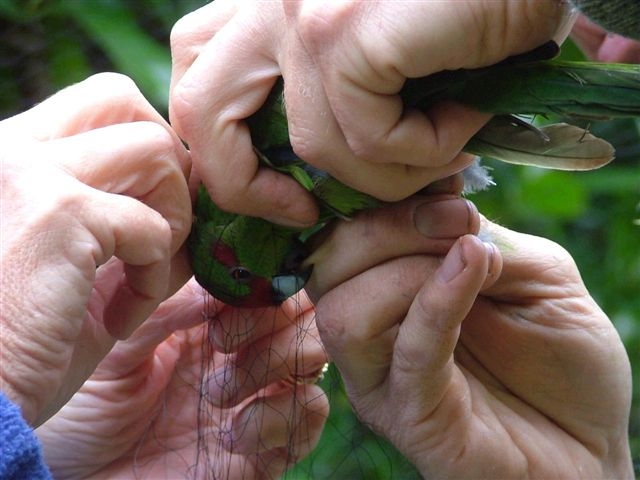
Working for the Department of Conservation from May-August 2003 was a great opportunity for me, and I picked up a lot of skills which practically form the backbone of my CV now. It was also an important turning point in my life, as it helped give me a new sense of direction. Having grown disillusioned from a series of failed attempts to ‘break into’ the film industry (ultimately deciding that from what I’d seen of it I wouldn’t want to work there anyway), and struggling to get over a painful relationship breakup, the job came at just the right time.
One of my first jobs for DOC was publicising the transfer of red-crowned kakariki from Kapiti to Matiu/Somes Island. It was one of several interesting learning experiences – before that I had no idea what a kakariki was, and assumed it was a kind of tree.
Fast-forward to May 2004. I was doing the Massey journalism course, partly on the premise that upskilling myself would improve my prospects of further work in the conservation field. I knew that there was a second kakariki transfer due. The first transfer was of all male birds, to assess whether they had any impact on the island’s vegetation before introducing females to start a breeding population. I thought I'd be helpful and write a news story about the second transfer. Since I’d seen the first transfer from the birds’ arrival end at Matiu/Somes, I thought it would be interesting to see & write about the birds at the capture end on Kapiti. I was also keen to go out and see Kapiti Island for myself, as I'd spent the summer looking at it every day while working for the Nga Uruora conservation prokect in Paekakariki.
A change at DOC since I worked there was that the Poneke Area Office’s community relations manager who’d employed me and who I had a good rapport with was away on maternity leave. Her replacement was less helpful to me and didn’t respond to my queries until the team was already on Kapiti and scheduled to leave the next day. So, thinking I’d use some initiative, I got a ferry booking at short notice and dragged Grant Hannis out of bed at 6am to lend me a camera. I went to the island, interviewed the DOC staff there, and was lucky to be there at just the right moment as a kakariki was caught. I got a good story and some great photos.
The trouble is DOC didn't want any publicity until a few days later, as it could cause some kind of problem with funding applications for the Matiu/Somes Charitable Trust, who were paying for the transfer (something to do with dates for funding rounds). But since the community relations people hadn’t involved me in the story they didn't tell me that. I got caught in a crossfire between DOC wanting to hold the story back and Diane Joyce at the Kapiti Observer wanting it right away or she wouldn't publish it at all. This was all happening minutes before the newspaper deadline on Thursday.
It occurred to me later that alternative options would have been for Diane to be willing to wait a few days, or if DOC were convinced the story would be harmful for it to not be published at all in that paper – the others would still have written something based on the DOC press release (such as the one-paragraph story that appeared in Capital Times).
As a compromise I sent the story to DOC to check over, and they cut it down from 730 words to 420 - which counts as censorship. I had to choose whether to accept this. Rather than submit the original out of principle or bloody-mindedness I went with the edited version.
Information that one of the birds in the last transfer had died, and that one of the ‘male’ birds was actually a female so the colony had started breeding prematurely, was excised. They also took out the part about the Matiu trust funding the transfer – which seemed odd since that was public information available on the DOC website. From there I went into a paragraph about what DOC are spending money on, which includes trying to save the only remaining population of orange-fronted kakariki, in Canterbury. That was removed as well, maybe as they thought it complicated the story - species transfer to offshore islands is not always a solution, and the orange-fronted kakariki live in beech forests which don't occur on islands.
I was left thinking I shouldn't have taken on the story at all if I had a conflict of interest. How would I handle a more serious story where DOC could be in the wrong? Not everyone's sold on 10-80 for example...
I asked Sue Galbraith, the DOC media advisor for advice on what constituted conflict of interest and got this reply:
Hi David,
It's great that you are interested in covering conservation issues. It's important though that the people you interview are aware that you are a journalism student and the story you are writing will be offered to the media. There would be a conflict of interest if you used confidential information that you had sourced through your role with DOC rather than through your research as a journalist.
We appreciate the opportunity to check over your conservation stories for accuracy. I am happy to offer advice. However I would appreciate more notice than you were able to give for this story.
Regards, Sue
One DOC worker on the island who I’d worked with last year had complained that I had not identified myself as a journalism student, thinking I was there as a DOC employee. However I only spoke to him for a few seconds, time to say ‘hi’ and not much else. I didn’t use him as an information source for the story, and certainly would have told him if there’d been more time. I made sure the people I did ask questions of knew.
As for ‘inside information’, I knew about the bird dying and the misidentified female from my previous involvement with the project. So it was legitimate for this information to be taken out of the story, though their reasons were because it would create a bad impression of their work. The information about the orange-fronted kakariki I obtained by phone research. It was taken out as they didn’t see it as relevant to the story. This seems to be coming from an attitude that PR people can decide what the story is – journalists should simply sit back and wait for the press release to arrive.
I found the whole experience uncomfortable, having a foot in both camps. I was pleased to be invited to Mana Island for a transfer of yellow-crowned kakariki there later in the month, and also to see a feature article in the Dominion Post on species transfer that went into some of the risks involved. There was no damage to the Matiu/Somes Charitable Trust’s funding chances that I know of, and my story seemed to be a workable compromise for DOC, myself, and the newspapers. As for furthering my DOC career though the diplomatic row may have done more harm than good.
http://fiffdimension.tripod.com